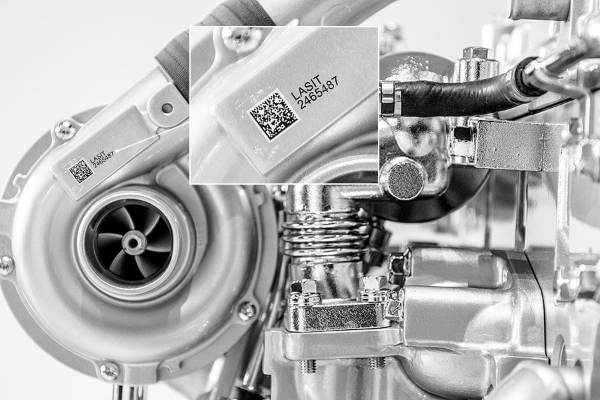

The production of automotive turbochargers presents technical challenges beyond simple component identification.
When one of LASIT’s clients, a European manufacturer specialising in this field, needed to combine laser marking, pneumatic leak testing, and optical thread verification in a single production process, the standard solutions available on the market were not adequate.
Out of this need came the LASIT FlyPress, an integrated system developed to meet a set of complex and interconnected requirements.
The company operates in a segment where quality control cannot be delegated to later stages of assembly. The concrete need was to verify pneumatic tightness and thread integrity directly at the marking station, eliminating component transfers between different stations and creating a direct correlation between identification and functional status of the part.
The main challenge in designing FlyPress was coordinating different technologies into a smooth sequence of operations. The system simultaneously handles high-speed laser marking, optical analysis for code and thread verification, and pneumatic leak testing, coordinating mechanical actuators, pressure sensors, and real-time vision systems.
The implementation of FlyPress has produced measurable results. The direct correlation between marking and functional verification has virtually eliminated the risk of marked but defective components continuing down the assembly line. This has reduced rejects at later stages and improved overall quality indices.
From a production point of view, the reduction in cycle time compared to a configuration with separate stations is on the order of 25-30%. This comes mainly from the elimination of component transfers and the parallelisation of some operations: while the pneumatic test is being performed, the vision system is already analysing the threads, optimising the use of available time.
Integration with corporate information systems has improved traceability. Each component has a complete record that includes not only the marked code, but also the process parameters used for marking, the quality grade of the verified code, the numerical results of the leak test, and the outcome of the thread verification. These data are useful not only for regulatory tracking, but also for process analysis and continuous improvement.
Maintenance of the system has proven to be manageable.The modular design allows targeted interventions on individual subsystems without requiring complete disassembly of the machine. Availability of critical spare parts and direct technical support helped maintain high levels of operational availability.
Contact: Barrie Rice