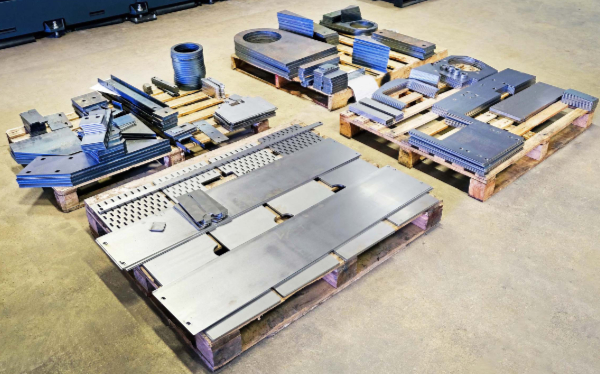

Helping to position Bell Steel Fabrications, Cricklade, for its next phase of growth is an 8 kW fibre laser profiling centre, supplied by BLM Group UK to replace an old flat-bed, CO2 laser cutting machine.
The fabricator manufactures an impressive variety of products for customers at home and abroad, while a distinctive aspect of the business is the production of bespoke stainless steel silencer and exhaust systems for classic cars, which accounts for 40 percent of turnover.
Established in 1977 as Bell Silencer Services, the company was founded as an exhaust centre in Swindon Old Town by former RAF airframe fitter and Concorde engineer Ron Bell. The operation relocated to Chelworth Industrial Estate in Cricklade in 1999, where two units now provide a total of 2,675 square metres of factory and office space.
The current managing director, second-generation Matthew Bell, first came across BLM on the company’s stand at the MACH 2010 machine tool exhibition in Birmingham. He and his father became interested in an ELECT 80 electric tube bender and after visiting an existing user in the north of England, they decided to place an order.
Fibre lasers have largely taken over from CO2 for cutting sheet metal, as they are less costly to run and maintain. They are also more compact, with fewer moving parts and no mirrors requiring regular alignment. They waste far less energy during beam delivery and convert more of their output into usable laser power. Moreover, gas usage is less with a fibre laser, as it needs only an assist gas, either nitrogen or oxygen, whereas a CO2 model also uses lasing and purge gasses. Mr Bell estimates that his company will save £20,000 a year in electricity and gas costs.
A vast range of components are produced in the machine from mild steel, stainless steel or aluminium, a large proportion of which also visit a CNC press brake. They range from brackets, flanges and silencer baffles for classic car exhausts, to other vintage vehicle fittings like fuel tank, radiator, clutch, gearbox and chassis parts, to structural steelwork, architectural metalwork, mounting platforms for industrial machinery, bicycle racks, truck ladders and even fabrications that form part of draught beer dispensing units. Coded welders among the company’s 21 employees provide TIG, MIG, MMA and fusion welding services across the full range of materials processed.
Bell Steel Fabrications prides itself on being a solutions provider and partner, not just a subcontractor. While its products cannot be described as cheap, its management has always regarded value for money for its customers as a core principle. It therefore looks to suggest design changes where appropriate to lower production costs and once a project is agreed, to program jobs to be completed as cost effectively as possible.
In the latter respect, Mr Bell points to a key feature of the BLM LS7 that allows very rapid and economical laser cutting of multiple repetitive features, like dense grids of holes. Called Fly Cut, it avoids the traditional stop-start laser cutting of each individual shape before moving on to the next. In the case of a square or rectangular hole, a conventional production route involves acceleration of the head to cut one side and then three further direction changes to produce each individual hole.
In contrast, Fly Cut synchronises the movement of the cutting head with rapid switching of the laser beam. The control identifies all horizontal lines in a grid of holes and cuts them in a single, continuous sweep across the sheet. The head moves at a high and constant speed while the laser beam pulses on and off where the holes need to be. After completing the horizontal passes, the machine repeats the process for the three other orthogonal directions. In this way, a time saving of up to 70 percent can be achieved for this part of the cycle.
It is notable also that fewer stops and starts translate into less stress on the linear motors and drive systems, potentially extending the lifespan of the machine’s motion components. To cut grilles successfully in this manner, the machine has to be precise and rigid to ensure that the lines meet at the corners. So Fly Cut not only saves cycle time, but is also direct proof of the quality of a BLM machine.
Another aspect of the LS7 that impresses Mr Bell is its adaptability. If in the future he chooses to use compressed air as the assist gas on some jobs to save on nitrogen or oxygen costs, a third line is available and a dedicated turnkey air centre is offered. It includes a high-pressure compressor, filter banks to remove any oil and water from the air and a reservoir to ensure constant air flow during cutting.
A further advanced feature of the machine that maintains high productivity is Active Piercing, which monitors when the piercing process is complete so that the subsequent axis movements to execute the programmed cut can start automatically. Conventionally, an operator has to calculate the time required for piercing the material and then typically adds a little extra time as a safety factor, which over the course of a day accumulates into a sizable amount of unproductive time.
The laser cutting head has a system for automatic focus position adjustment, so the operator does not have to manually change the focus position when changes are made, such as in the assist gas used or the type or thickness of material being cut. It is another productivity-enhancing measure, as is automatic nozzle changing from an 18-position magazine, which also cleans the nozzles and monitors their wear status during exchange.
Production at Bell Steel Fabrications is characterised by small batch sizes and one-off prototypes, with large runs being relatively uncommon. For this reason, Mr Bell chose not to automate material transfer to the BLM LS7 at this stage. However, if a future need arises, tower storage and handling systems are available from BLM to work in conjunction with the standard, dual-table shuttle system of the fibre laser machine. Notably, it is one of the fastest on the market, material changeover taking only nine seconds.
Investment in BLM Group’s LS7 fibre laser profiling machine marks a significant step forward for Bell Steel Fabrications, delivering measurable cost savings, increased productivity and enhanced process flexibility. By combining advanced laser technology with a commitment to engineering excellence and customer value, the company is well positioned to expand its capabilities and remain competitive in a demanding subcontract manufacturing environment. The transition not only modernises the company’s production infrastructure, but also reinforces its reputation as a forward-thinking fabrication partner.
Contact: Jon Curtis